
Credo – We the disconnected
Yesssss, it's finally here, the new album by British proggers Credo. It took fifteen years to get the band's fourth (studio) album released, fifteen years in which many obstacles have been overcome and setbacks turned time into an enemy. But what a joy it is to listen to this album, correction, this double album because we are presented with more than eighty minutes of the highest quality prog.
My history with this band goes back to the release of their second album Rhetoric. I immediately fell in love with the melodic neo-prog of the men around charismatic singer Mark Colton who adds very beautifully worked out lyrics, often critical with depth, to the music. There was room for all instruments and the solos on keys and guitar were almost innumerable. I have also seen them live once and that in a disappointing setting with only about thirty supporters. Successor Against Reason is at least of the same level and fortunately the band can still be heard in almost the same line-up on We the Disconnected. Instead of Martin Meads we now hear Gerald Mulligan on drums.
Keyboardist Mike Varty can be seamlessly placed in the list with Clive Nolan, Mark Kelly, Martin Orford etc... because he also has that nice and elegant touch in his playing that I love so much. He is also responsible for the mixing/production and the album sounds really good. Guitarist Tim Birrell is a guitarist who is allowed to shine with his melodic solos in all tracks, yes all tracks, but also creates atmospheric passages that we know from Steve Rothery of Marillion, for example. The rhythm section consists of Gerald Mulligan on drums and Jim Murdoch on bass and if you are talking about a solid foundation then you have to be with them. Tight, but occasionally frivolous and playful.
The album kicks off with the immediately thunderous Losing my Reason, in which Colton wonders what value we still have as we get older and less attractive to society. It's not a happy message but this track makes me so happy because this is neo-prog as I like to hear it. There are certainly similarities with the earlier Arena, especially the driving rhythm and the alternation in tempo and intensity. Colton is a very distinctive vocalist and the backing vocals are also appropriately placed. I have to say something, I like it so much when a band takes the time in their tracks and has the guts to incorporate several solos on keys and guitar. The balance between vocal and instrumental pieces is essential for me and that balance is perfect on We the Disconnected. And while we're on the subject of balance, the alternation between quiet and heavier pieces also makes this album so incredibly nice to listen to. There are few bands that do this so well.
As already mentioned, Colton is not a writer who creates easily digestible stuff, his lyrics are without exception astute and it is clear that he takes melancholy and the heavier side of life as a starting point. Take the trouble to sift through them sometime and keep them next to the music as you listen. It is worth it. His voice has a bit of bite as we know it from Fish and that is not so strange considering he also sings in a cover band playing old Marillion tracks.
Table for One is a bit more laid back but develops into an intriguing track about feelings of loneliness and sadness but succeeds in creeping into your mind with its haunting melody.
Initially, I planned to describe the album track by track, especially since there are only eight on this double album. Yes, eight, so that means long(er) tracks with a lot of variation within the track itself. That's also something I love, it makes it possible to see a track as a complete piece of art with all the trimmings. Often, or actually almost always, there are tracks on an album that you don't like as much. Well, not this time. Whether it's the more than fifteen minutes long Flowers by the Roadside, about the tangible monuments for the victims of fatal accidents, or the almost completely instrumental Bonkersaria, everything is spot on. The use of an (artificial) choir in that last song is another example of the sense of drama this band is able to create.
For the loyal followers, it is also nice to see that the song Round and Round, which has been played live for some time, is finally on a studio album in all its glory. Mark describes this song as "The Drug Song", and then I don't have to explain what this song is about, right? More than twelve minutes with passionate vocals, swirling keys, guitar solos to feast on and changing rhythms that build up and decrease the tension, it's all there.
Since they decided to give each track space to breath, there is enough room for quiet passages with wonderfully floating keyboard parts by Varty and the tasteful picking of Birrell, but if it has to rock, Mulligan and Murdoch are right there to step on the gas. Mind you, no metal, no showboating but rock-solid neo-prog with melodies that touch and stick. You hear that attention has been paid to all details and that is the advantage of a long time frame, you can work out songs to perfection and tweak where necessary and you can definitely hear that.
So the already high level of Rhetoric and Against Reason is even surpassed on We the Disconnected. Some people dislike the term neo-prog, well, clearly I don’t since it is a way of describing music more precisely as progrock has become a genre with many subgenres. I don’t want to narrow down the boundaries but just want readers to know what they can expect. So, expect a lot from this one!
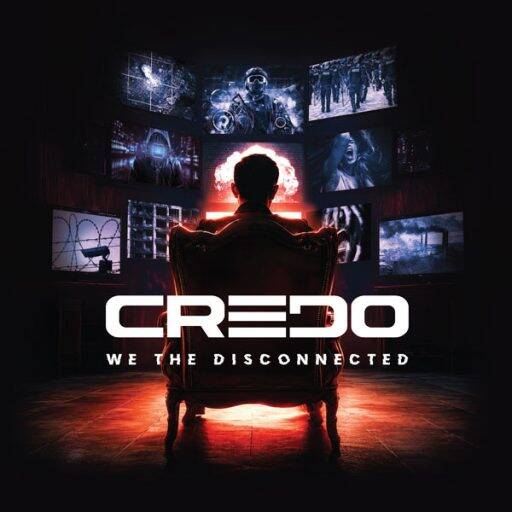
The cover shows a man surrounded by screens and is a perfect match for the lyrics, the almost uncontrollable influences we perceive every day are not easy to digest without becoming a bit gloomy and lost. How do we shape our lives in this modern world and how do we process the rapid-fire of changes and temptations?
Credo are back! With their finest album ever, a neo-prog gem and one of the candidates for my album of the year.
Music 93
Cover 86