
Pallas – A Song for Tomorrow
We are not saying too much when we say that the Scottish Pallas is one of the founders of the neo-prog movement at the end of the seventies of the last century. Among the names like Marillion, IQ, Pendragon, Twelfth Night and Solstice, we should not underestimate them in their influence on these contemporaries. The bombastic prog of yesteryear has taken on a somewhat different character but is still dynamic and dark. Especially after Alan Reed's return to the old nest, the magic is still present and perhaps more than ever.
The previous album The Messenger is still one of the best albums ever for me, despite the fact that there is no longer a drummer of flesh and blood to be heard. Yet the programming of the percussion is hardly distinguishable from the real thing, so well has guitarist Niall Mathewson done it. Reed's voice has changed and that may be because he has fallen prey to the terrible disease Parkinson's. I say changed but not necessarily less because on The Messenger he sounds downright great. Can the Scots surpass the masterful 2023 album?
Whether it's because of Reed's condition or because of the desire for more vocal variation I don't know, but on the new album A Song for Tomorrow the vocals are done by all four band members and yet Reed is still a whopper. His vocal contributions still stand out, and the harmony vocals are really beautiful, the emotion often drips off in thick layers.
A Song for Tomorrow contains ten tracks and they clock between 4 and nine minutes and that means no real epics and I regret that a bit. It is striking that a lot happens in terms of dynamics, ultra quiet parts are interspersed with quite exuberant and bombastic pieces. That's not new for Pallas, is it? Not in itself, but where that usually used to happen within a track, a number of tracks now stand out because of a consistent tempo and atmosphere. What Pallas really excels at is creating a dark, ominous atmosphere and that fits in flawlessly with the theme of the album. So no light fare.
Opener Reset is a more exuberant song with some moments of rest. The bombastic beginning is clearly Pallas and the harmony vocals are immediately noticeable, after a little more than four minutes it is over and that is a pity. If a title says something about a track, and that is the intention, then Rage is well chosen. This rather short song does indeed contain the feeling that covers the load, with an immediate heavy rhythm. Initially not much room for instrumental ingenuity, but for ripping guitars and a heavily distorted solo. For a moment we are taken out of this mood by a short, very quietly sung interlude to end up in considerable chaos with wailing sirens.
The title track is a bit strange, Natasha O’Neil takes care of the female lead vocals and the chorus in the first, very quiet keyboard-carried, part of the track and later together with the others. Vocally it is beautiful. Only after more than four minutes does that dark Pallas atmosphere come in and then the song blossoms into a wonderful finale, but without too much instrumental Ingenuity. I feel like there could have been more to exploit here.
With more than eight minutes, The Private Collector is one of the highlights of the album. Right at the beginning we hear bombastic chords after which, on an electronic rhythm, the harmony vocals give you goosebumps. The mystical atmosphere remains present throughout the song and we hear Mathewson and Murray clearly. Here too, the expected guitar solo fails to materialize and yet it remains fascinating until the end. This is certainly also due to the almost esoteric passage just before the end. After a slow opening, DIRT gets going and after a spicy piece the time finally arrives for Niall who plays a wonderful solo against a heavy background of keys and bass pedals. This is Pallas at its best. Reed's vocals in this track come more in the direction of the older work, it said, with a fragile edge.
The entire album actually has a pretty cinematographic character and could indeed be a soundtrack to a sci-fi movie with a dystopian theme. Yet Aspirations is even more visual, this very quiet and drawn-out song contains acoustic guitars and many keys and has to rely on the beautiful harmony vocals. The atmosphere is decisive because an instrumental outburst is omitted and that is a loss. Especially if the dark tones really invite to do so towards the end. The next Rushing Headlong is rhythmically quite difficult to follow and even after listening to it many times, I have to admit that this track will not be in my Pallas playlist. The melody doesn't really captivate and it rumbles on a bit.
How different is The Avenue of broken Dreams, a long intro with soaring keys and subdued vocals is complemented by acoustic guitar. The unmistakably ominous atmosphere is really beautifully portrayed and steadily it all gets a bit heavier and we hear Niall with powerful chords on the electric guitar. The melody takes a turn and gives you a more light-hearted feeling. The finale with a modest guitar solo really gives me goosebumps.
The sensitive side of Reed comes to the fore in the rather short Mother. I have never heard him so fragile and sincere. The track remains very quiet with a pulsating rhythm and as O’Neal appears again to sing with Alan, this results in another intriguing song, though instrumentally not that fascinating
Saving the best for last is not uncommon for many bands and Pallas is no exception. Inside Outside is truly a worthy finale to this album. It gets boring, but that harmony singing......, so beautiful and poignant. Mathwewson's contributions on guitar are so tasteful and if this turns out to be the swan song of the Scots then it is one that can be admired forever.
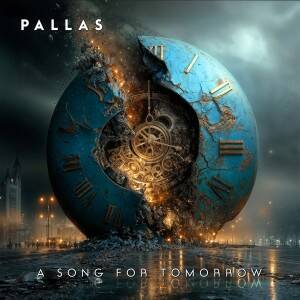
I can't help but talk about the really beautiful artwork because it is of exceptional class. Mike Bentley is responsible for this and I simply don't know enough about artwork to determine the extent to which AI has played a role in this. The whole discussion about the ever-growing influence of AI is of course a tricky one because let's face it, it's both a curse and a blessing. This review is not the place to have that discussion, but I dare say that I have rarely seen such striking artwork.
As for the lyrics, it may be clear that they are not very uplifting and mostly reflect the current zeitgeist with all its problems and challenges. But mind you, there is some light in some of them. As always, everyone should hear what they want in them, they leave enough room for that.
The Scots do not always choose the smoothest melodies, which means that some tracks are less accessible and, after frequent listening, remain. Compared to The Messenger, there are more shorter tracks on A Song for Tomorrow. Vocally, this is without a doubt Pallas' most ambitious album ever. It is known that they will not perform live again and Reed's health makes a sequel unlikely, at least in the current situation. With both The Messenger and A Song for Tomorrow, the band shows a mighty final sprint of a long career with an impressive series of albums.
Music 90
Cover 94