

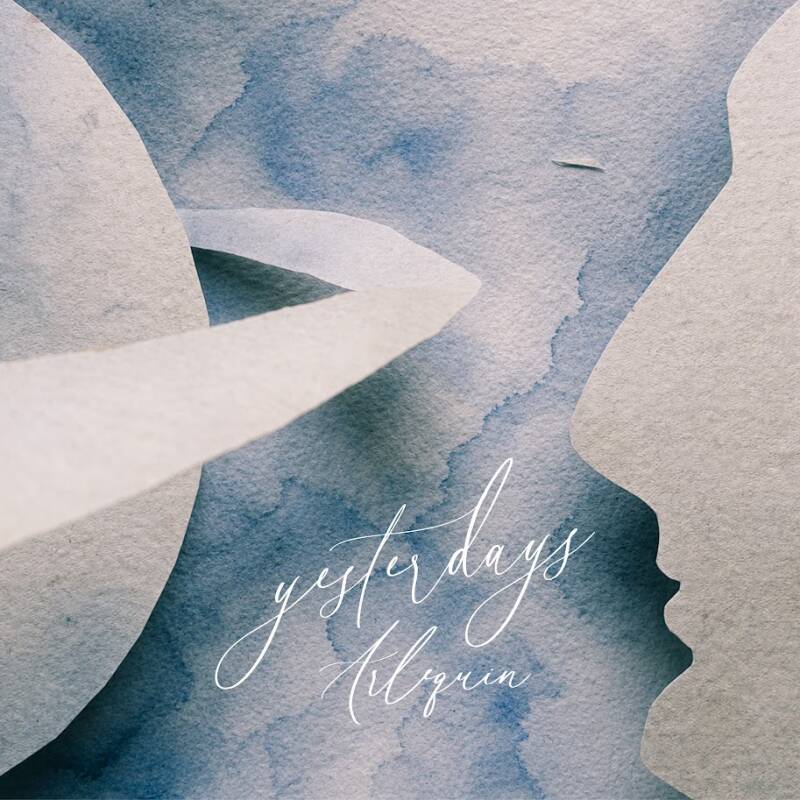
Yesterdays – Arlequin
It is not often that you get the chance to write a review about an album by a Hungarian band (with Romanian connections). My last acquaintance was with the album by The Android – Another Midnight Ball, but they sing in English and that is not the case on the new album by Yesterdays, entitled Arlequin. The Hungarian language sounds like a typical Slavic language to me and the message is indecipherable while you listen. Fortunately, all the texts in the booklet are translated into English, but it takes some getting used to. There is a lot of attention for the background and harmony vocals and that is probably due to András Karola, who has been used exclusively for this task, and Kósa Dávid who is mentioned as a percussionist in addition to being a background singer.
One thing is certain, you have to be a real lover of the all kinds of flutes, played by Kecskeméti Gábor, if you want to appreciate the music of Yesterdays because this instrument has a very decisive role in the overall sound of the band. Still, the music does not resemble that of, for example, Jethro Tull, Camel qualifies as a reference, but that comparison is also only partly valid. What also stands out is the quite cheerful character of the music. Where melancholy often forms the basis, this is not the case here. What may also help is the female vocals, Torma Zsanett sings well and I do hear a clear resemblance to the earlier work of the Polish Quidam. I sometimes hear a bit of Yes and that is mainly due to the keyboard work of Tóth Gábor.
The album contains nine tracks and they clock somewhere between two and twelve minutes, so plenty of variation. Arlequin ébred (Harlequin awakens) really starts as a Yes track could start, quite up-tempo and lots of short keys and guitar solos that alternate and of course the aforementioned flute that swirls in between. The lyrics speak of a harlequin/Jester who has to take off his mask and be himself without fear or shame. Kekbol szurkebe (from blue to grey) actually continues in the same style and that already indicates that Yesterdays has a clear vision and the fact that the musicians are all technically very good makes that vision perfectly possible. Guitarist Bogáti-Bokor Akos, who also takes care of the bass, clearly plays differently than Steve Howe so it doesn't sound too much like Yes, his style goes a bit towards fusion. Hajnalodom (Dawning) starts with a somewhat slower tempo and contains some more moments of rest and that is a good choice that greatly benefits the balance on the album. The text here is a bit darker in nature and describes a man who is searching for himself in a changing situation, at least that's what I get out of it. To be honest, I do find the many flute passages very dominant, but I prefer the flute to the saxophone, so go on, don't whine. Drummer Zsigó László plays impressively tight and varied. Don't draw the wrong conclusion, there are really solid chords on guitar and the rhythm also changes regularly. The short Amito tanc (Deceptive Dance) combines acoustic guitars with swirling flute and some bells here and there to end a bit spicier, so still a bit Jethro Tull after all. In Keseru szurke hold (Bitter Grey Moon) you would find a combination of Yes and King Crimson but with more ...., right, flute. Especially in the guitar work you could recognize Robert Fripp and the keyboard solo goes more to Wakeman, for example. Those are quite big names and that indicates that the music is quite good. What I don't like so much are the melodies, they touch me less and don't really stick and yet I do enjoy listening to this album. Vizfeztek (Watercolour) is the shortest track with two minutes and is carried by the acoustic guitar and the, exactly .. flute. With Holnapok (Tommorows) we get the longest track on the album. Violins and flute form the intro and as soon as Torma starts the vocals, the track starts to swirl and the keyboard work alternates beautifully with the guitar that now sounds more like Hackett. The staccato pieces sound a bit jazzy, the double vocals sound somewhat manipulated and there is a bit more room for instrumental breaks. The combination of violins, cello and flute returns and pours a classic sauce over this track. Just when you think you are going to a very exuberant and melodic finale, a contrarian piece comes along with solid guitar work. The alternation between complex pieces and the more melodic ones is very successful here.
The ninth and final song is a bit of an odd one out. Drift away (from Black and White) is sung by Joe Payne and seems to be an attempt to storm the charts. It's a short pop song with a bouncy rhythm and despite the fact that Payne is a great singer, this song doesn't touch me at all. If it were to pass by on the radio, it wouldn't even be noticed. If it had been up to me, I would have left this number out.
Arlequin is an ambitious album, played and sung with verve, that could just charm many prog lovers. I have already mentioned (too often?) the major role of flute playing, and the Hungarian vocals are also something you have to be able to cope with, but if you succeed in all this, then you get to hear a very nice piece of music. With one foot firmly in the 70s of the last century and the other in the present day. The cheerfulness of the music does not always go hand in hand with the lyrics that very regularly sketch wintery, cold atmospheres. But as always for me, music first and, although important too, lyrics second. And finally, or third, the cover is somewhat dull and looks a bit like a postcard, nice colours though.
Music 70
Cover 60